Goodbye PRDs: how releases absorbed them
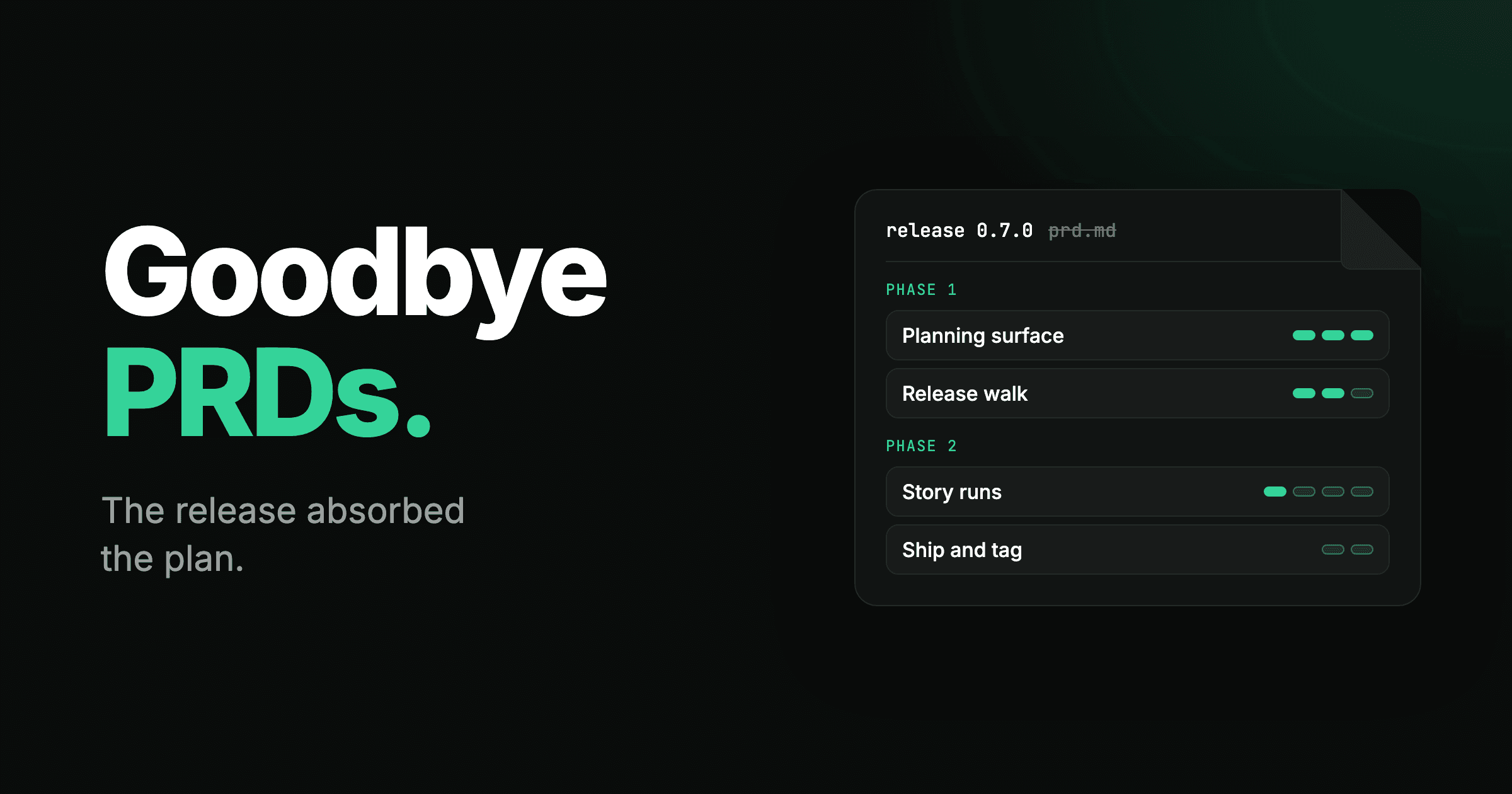
For about nine months, Trinity was built around the PRD. As of 0.7.0, the PRD is gone.
A release now holds everything a PRD used to hold, and the tree is the same everywhere: release, phases, epics, stories. This post is about why we got rid of a concept we built the product on, and what it means for you.
"PRD" was never our word
PRD came in with the Ralph world: one requirements document, one agent loop working through it. We told that story in The Ralph Wiggum Loop, evolved, and for a single loop the shape fits. One document, one run, done.
So Trinity started PRD-centric. A PRD held phases, epics and stories. The plan, the roadmap and the progress all lived on it.
It was never a good term. It is jargon from a corner of the tooling world, and it describes a document, not the thing you are building. Everyone already knows what a release is.
Each patch was reasonable
Then work stopped fitting inside one PRD.
A release started to hold several PRDs, and some work did not belong to any of them. So we patched. Small work needed somewhere to hang, so we allowed loose stories. A group of work beyond one PRD needed a home, so we allowed loose epics.
Each patch made sense on its own day. Together they said the container was wrong. The tree had two layers of exceptions:
- A release with several PRDs and a few loose stories.
- Epics that sat outside any PRD.
- An Architect drafting "PRDs" that did not map one to one onto anything real.
- Roadmaps and planning context with no clear owner.
A concept you have to explain before anyone can use the product, and then keep patching to cover the work it cannot hold, is usually the wrong concept.
The release is the thing being worked on
The insight was simple. A release is what you are building. Its phases, epics and stories all stem from what that release needs to be. A release can absorb what a PRD really was.
It's release-centric. That's legit.
So we moved everything the PRD owned onto the release, and removed the layer. The shape is now always:
| Before | Now | |
|---|---|---|
| The container | A PRD, inside or beside a release | The release |
| Loose work | Loose stories and loose epics | None: every story sits in an epic, every epic in a phase, every phase in a release |
| Roadmap and planning context | On the PRD, or nowhere | Owned by the release |
| Complexity tier | Per PRD | Per release |
| Dependencies | Rollups, cross-release story edges, buffers for loose work | Releases depend on releases; stories depend on stories inside one release |
This is a big simplification, not a rename. Whole mechanisms went away: epic and phase rollup dependencies, story edges that reached across releases, and the buffer that held loose work. Once the release is the container, dependencies come down to two plain edges.
What changes for you
The release owns its plan. Its roadmap, its planning context and its complexity tier live on the release. There is no second object to keep in sync.
One page per release. A release's page has three tabs: Conversation, Stories and Graph. The Stories tab shows the release's tree, and the old Stories index is gone because there is no longer anything outside a release to list.
A two-level graph. The Release Graph is the bird's-eye view: your releases and how they depend on each other. Open one and you see that release's story graph, with a breadcrumb back out and a stub where a dependency leaves for another release. The graph guide walks through both levels.
The Architect plans one release's tree. Each Architect thread owns its release from the first message and keeps one draft tree and one roadmap current as the plan changes. The dependency mapper stays inside the release. Small work is a small plan, one phase with one epic, and big work is more phases in the same release. See the Architect for how a plan goes from request to committed tree.
Releases run as one unit. A release is gated by its checkpoints, and branch templates use {release} where they used {prd}. Follow-up and must-fix stories get a home too: the open phase's Follow-ups epic, or a Follow-ups phase once every phase has landed.
What we learned
We held the PRD longer than we should have, and each patch made the next one feel more natural. The signal was there early: people asking "what's a PRD?" before they could use the product.
We are leaving the earlier posts as they are. They are the record of where we came from, PRD vocabulary included, and rewriting them would hide the path that got us here.
If you are on 0.7.0, your plan is already a tree of release, phases, epics and stories. Open a release and look at its tabs.
New to the release-shaped plan? Download Trinity, start an Architect thread, and watch one release grow into its phases, epics and stories.