Stop waiting for a better model. Build a better system.
In the last three weeks, the two best AI models on the planet shipped — and both got throttled before most developers could touch them.
GPT-5.6 launched to a list of government-approved partners. Claude Fable 5 went live, then vanished days later under a U.S. export directive. The capability is real. The access is not — at least not on your schedule.
So if your plan to ship software faster is wait for a better model, that plan now rests on two things you don't control: that a lab releases the model, and that you're cleared to run it.
There's a third option, and it's the only one you actually own — get more out of the model you already have.
The frontier is being rationed
For two years the deal was simple: every few months a better model dropped, you swapped it in, and everything you built got smarter for free. That deal is quietly expiring.
When OpenAI shipped GPT-5.6 Sol, Terra, and Luna on June 26, it limited the rollout to a small group of partners — names approved by the U.S. government — and said plainly that restrictions shouldn't be the norm. Anthropic's Fable 5, a Mythos-class model that topped nearly every benchmark, was pulled within days and only cleared for a limited, license-revised release. A new White House order now asks labs to let the government assess a model's capabilities before it goes out the door.
The models keep getting dramatically better. What changed is that "better" and "available to you" came apart. A model can be state-of-the-art and still not be yours this quarter.
Waiting on the model was always a passive bet. Now it's a passive bet on someone else's release calendar and someone else's policy review. That's a strange thing to hang your team's velocity on.
What the harness crowd already figured out
There's an argument going around — loudest among the people who actually ship with these tools — that the model was never the moat. The harness is.
The harness is everything wrapped around the weights: the tool-calling loop, the prompts, the guardrails, the behaviors that decide whether a model writes code or writes shippable code. Cursor's bet made it concrete. They didn't wait for a frontier model — they post-trained their own and baked tool-use behavior straight into it, and it punches well above its raw size because the harness around it is tuned.
It's a great bet. But notice its shape. Behavior baked into weights is frozen between releases. To make it smarter, you retrain and ship the next version. That's still a release cycle — they just moved the waiting problem from the lab's clock to their own.
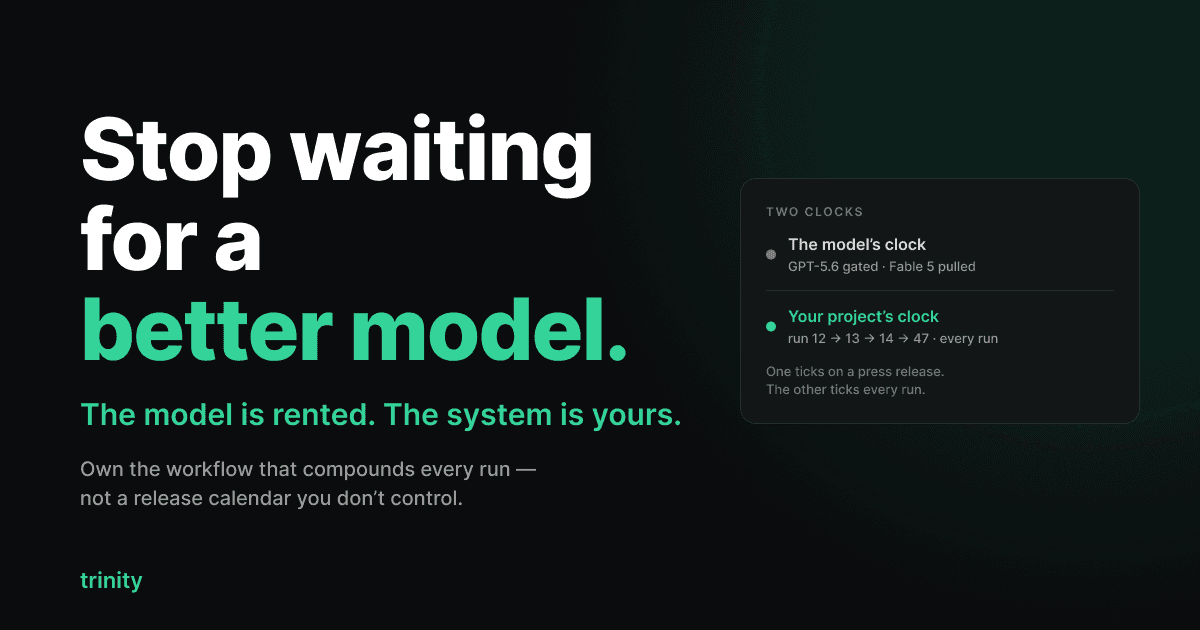
Two clocks, and you're standing next to the wrong one.
Theirs. You wait. You may not even get access.
Yours. Every run. Owned.
One clock ticks on a press release. The other ticks every run.
The model's clock ticks on a press release — and lately, on a government sign-off. Your project's clock could tick on every single run. The whole game is deciding which clock your improvement rides on.
A system that learns between model drops
This is the bet Trinity makes: the system around the model should get smarter on your clock — continuously, inside your project, owned by you. Three mechanisms make that real, and none of them wait for anyone's release.
Memory that feeds the whole pipeline
Every run, Trinity's agents read and write a project knowledge base and gotchas library — organized into books, chapters, and pages, tagged to your actual stack. An agent hits a framework quirk, verifies the fix, and writes it down. The next agent reads it before it touches the code and routes around the trap. We told the long version of that loop in The Ralph Wiggum Loop, evolved — run 1 discovers the bug, run 2 avoids it, run 47 is a living gotchas library no single developer could maintain.
The part that compounds hardest is where it pays off first. The Architect — the agent that plans the work — reads that same memory before it writes a single story. The highest-leverage decision in the whole pipeline, how the work is structured, gets made with everything the project has already learned in context. The plan routes around known traps before any code exists.
One memory. Every stage. Planning reads it, implementers build against it, auditors check against it.
The model is rented. The system is yours.
A harness that fixes itself mid-turn
A model has a good day and a bad day. A guardrail doesn't.
When a Trinity agent produces something with a hard correctness bar — a dependency graph, a rendered diagram — it doesn't hand it to you and hope. It validates the output against a real parser, gets the exact errors back as structured data, and repairs them in the same turn, before anything reaches you. A broken diagram never renders. An invalid graph never commits.
Correctness that doesn't depend on the model's mood
Self-repair loops turn "the agent usually gets it right" into "the agent can't emit it wrong." The guardrail catches the mistake and feeds it back deterministically — so output quality stops riding on whether today's model is sharp.
This is the harness insight taken one step further than baking behavior into weights. Instead of training the model to be right more often, you build a system that refuses to accept wrong — and that system improves the moment you add a new check, not the moment a lab ships a new checkpoint.
A toolkit that extends itself
The third mechanism is the one that carries across projects. Trinity's Runtime lets you create new skills by describing them, and when you import an existing repo, it lifts the skills already living in your codebase and stages them for review. Skills are scope-aware — global, or pinned to a target or a repo — so a lesson learned in one place travels exactly as far as it should.
So the harness isn't a fixed set of behaviors someone at Trinity hand-tuned and froze. It's a rail that grows from your work — and the next project starts smarter because it inherits the books and skills the last one earned.
This isn't anti-model
Let's be fair about the trade. A better model still helps — a lot. The point isn't that models don't matter; it's that they're not the only axis of improvement, and they're the one you control least.
The two stack multiplicatively. A compounding system makes whatever model you can access punch above its weight, and it de-risks you from the throttle — when access tightens, your planning, memory, and guardrails don't change. That's the same instinct behind treating the harness as swappable, not locked-in: keep the valuable, durable part above the layer that vendors and regulators keep moving.
| Wait for a better model | Compound the system | |
|---|---|---|
| Who controls it | A lab — and lately a government | You |
| When it improves | On a release, if you’re cleared | Every run |
| Where it lives | In someone else’s weights | In your project, tagged to your stack |
| What you keep | Nothing until the next drop | Books and skills that carry forward |
| If access is pulled | You’re stuck waiting | Same system, different engine |
When the next model finally clears review and lands in your hands, you don't reset — your accumulated system makes it immediately better-applied. Compounding doesn't compete with the frontier. It compounds on top of it.
Tired of waiting?
Come back to where we started. The best model this month shipped to a government-approved list you're probably not on. Meanwhile, the system you own could have planned, built, reviewed, and documented real work today — and gotten a little smarter doing it.
That's the quiet shift worth internalizing: the labs are slowing down at the exact moment the thing around the model is speeding up. One of those you wait for. The other you build.
Tired of waiting for a better model? You might just need a better system around the one you already have.
See what compounding feels like — download Trinity for macOS and Linux, and watch the first-pass rate climb as your project's books fill in.